
Vaidyanath 03 / 08
Temple and Architecture
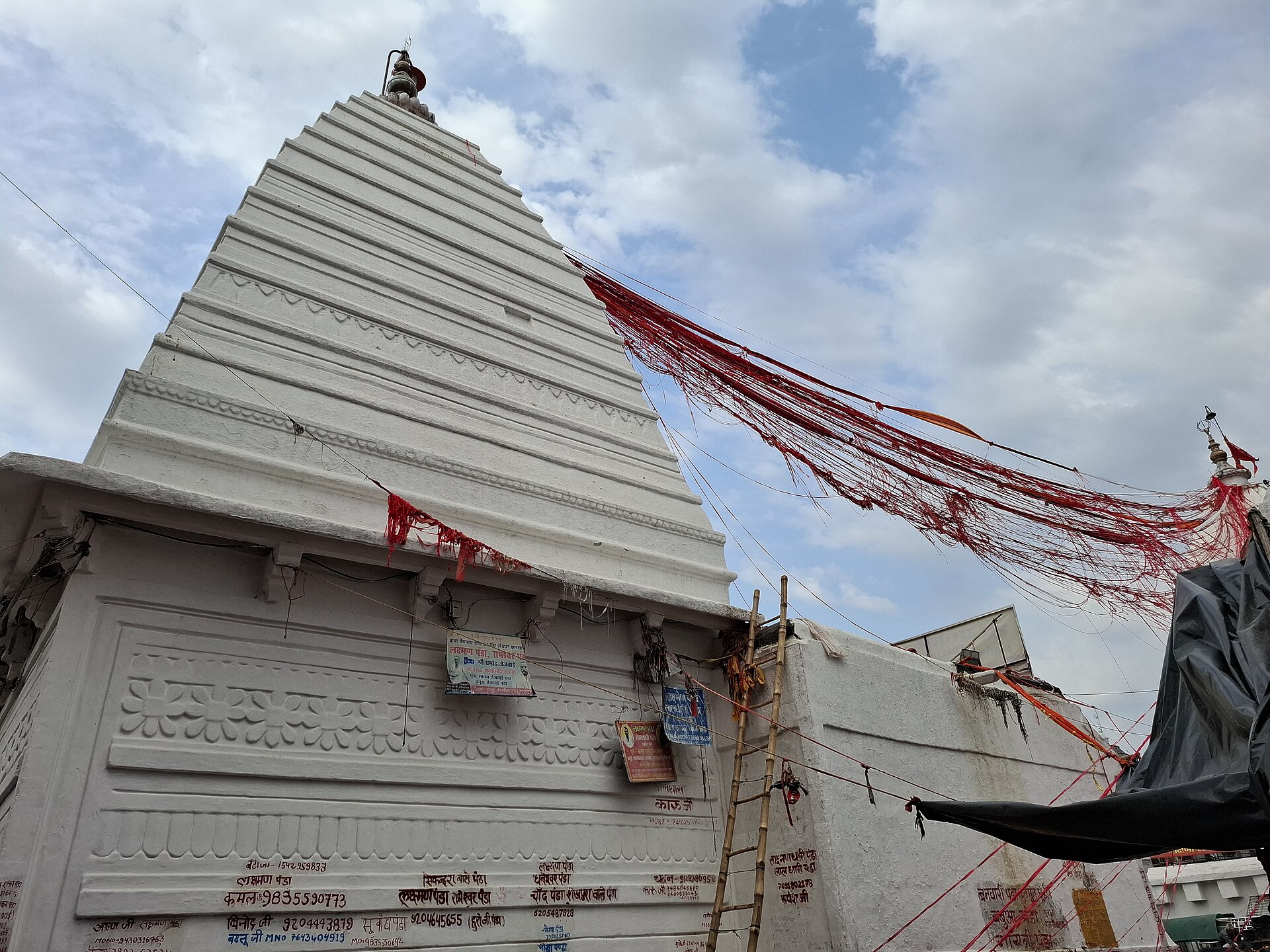
A pyramidal spire at Deoghar, and how the three temples differ
The Deoghar temple is described as a Nagara-style shrine with a pyramid-shaped shikhara inside a complex of smaller temples. Counts and height vary between sources, and no measured survey was available to us. Parli is described as Hemadpanthi and Baijnath as Nagara with inscribed dating.
01 · Deoghar
The shikhara and the complex
The temple's site describes classic Nagara-style architecture with carvings and a towering shikhara, and says the sanctum houses the Jyotirlinga beneath a pyramidal shikhara. Wikipedia likewise gives a Nagara style and pyramid-shaped shikhara. The photograph here shows a stepped, whitewashed spire; red sacred threads tied by devotees stretch from it, and the lower wall carries painted names and numbers.123Unverified

| Item | What a source says | Source | Our note |
|---|---|---|---|
| Height | 22 m | Wikipedia | Not confirmed by an official page. |
| Height | 72 ft (reported in a search summary) | Jharkhand Tourism | Page not opened; roughly consistent with 22 m but not used as fact. |
| Other shrines | Main shrine surrounded by 22 smaller temples | Temple site | Site is inconsistent about which deities. |
| Other shrines | Central shrine plus 21 additional temples | Wikipedia | Relationship to the website’s count remains unverified. |
| Inside the complex | Jai Durga Shakti Peetha (Hridaya Peetha) | Temple site | Presented as tradition. |
02 · Compared
Three temples, three descriptions
| Temple | Style and form reported | Source |
|---|---|---|
| Deoghar | Nagara; pyramid-shaped shikhara; main shrine in a complex of smaller temples | Temple site, Wikipedia |
| Parli | Hemadpanthi; reported height of about 75 to 80 feet; brass-plated east door | Wikipedia (one travel guide behind it) |
| Baijnath, Kangra | Nagara; curved shikhara, pillared mandapa and vestibule; carvings including Ganesha, Harihara and Shiva's wedding; protected by the Archaeological Survey of India | District page, Wikipedia |
Style alone does not identify a Jyotirlinga, and none of these descriptions bears on the textual question set out in Story and Tradition. We list them so a visitor who goes to more than one of the temples knows what to expect.Interpretation
Sources and notes
Sources and notes
Each source is marked as inspected for this project or only discovered, so you can see how far a statement has been checked.
- Baba Baidyanath Dham website (babadham.org): home, about, story, timings, festivals, visit, attractions and FAQ pages. Link Inspected · Accessed 2026-11-14 Presented as the temple's own site (the Baba Baidyanath Dham Temple Trust is named in its footer); we did not find a government page that confirms this. Read on 14 November 2026. The FAQ page lists questions without answers; the home page shows placeholder statistics; the site gives two different distances in several places and closing times that do not agree with each other. Its institutional authority remains unverified; its statements require confirmation before travel.
- Baidyanath Temple, Deoghar (Wikipedia). Link Inspected · Accessed 2026-11-14 Read for leads only: the Ravana legend, the Matsya Purana mention, the Gidhaur rulers (state founded 1266), the late 18th-century East India Company administration, 22 m height and the temple count. Primary works it cites (Choudhury, Lochtefeld, Chaturvedi) were not read. The last 6,000 characters of the page were not read.
- Pinakpani. File:Baidyanath temple and temple complex, Deoghar 01.jpg (Wikimedia Commons) (2026). Link Inspected · Accessed 2026-11-14 Commons page read: author Pinakpani (own work), CC BY 4.0, described as the Baidyanath temple and complex at Deoghar, dated 28 March 2026.
- Jharkhand Tourism pages on Baidyanath Dham (tourism.jharkhand.gov.in). Link Discovered, not yet inspected Appeared only in a search summary, which said the state page calls the temple the most sacred place in Jharkhand, gives its height as 72 ft and its distance from Ranchi as 243 km. The pages were not opened, so none of those figures is used as a fact here.
- Shri Vaijnath Temple, Parli (Wikipedia). Link Inspected · Accessed 2026-11-14 Read for leads only: Hemadpanthi style, 75 to 80 feet height, a 1706 renovation and an 18th-century attribution to Ahilyabai Holkar. The article rests on one travel guide and is tagged for reliability; none of these is treated as settled.
- Shiv Temple, Baijnath, Kangra District website (hpkangra.nic.in). Link Inspected · Accessed 2026-11-14 District administration page. States that the temple honours Shiva as Vaidyanath, was built in 1204 AD by two local merchants Ahuka and Manyuka, is protected by the Archaeological Survey of India, and gives access information. It does not itself claim the Jyotirlinga title. Our fetch tool summarised the page; the inscription text was not read.
- Baijnath Temple, Kangra (Wikipedia). Link Inspected · Accessed 2026-11-14 Read for leads: two long inscriptions (Sharada and Takri scripts), the ruler Jaya Chandra named, repairs under Sansar Chand, 1905 earthquake damage, and the Dussehra custom. The article does not mention any Jyotirlinga claim. It contains an internal inconsistency about the Saka date, which we did not resolve.
Continue exploring
Continue exploring
- Plan your visit
Plan Your Visit
What are the darshan timings and how do I reach the Vaidyanath temple?
Read chapter - Overview
Vaidyanath
Where is the Vaidyanath Jyotirlinga, and why is the answer disputed?
Read chapter - History
History and Heritage
What is known about the history of the Vaidyanath temple?
Read chapter