
Omkareshwar 03 / 08
Temple and Architecture
A rebuilt temple with older parts, and a south-bank shrine of fragments
The Trust describes the Omkareshwar temple as North Indian in style with a high spire, with an older, smaller north-facing sanctum and a newer south-facing part that do not line up. A specialist article describes the Mamleshwar temple as largely reconstructed from older fragments. This chapter gives what we could read and no more.
01 · The island temple
The Omkareshwar temple as the Trust describes it
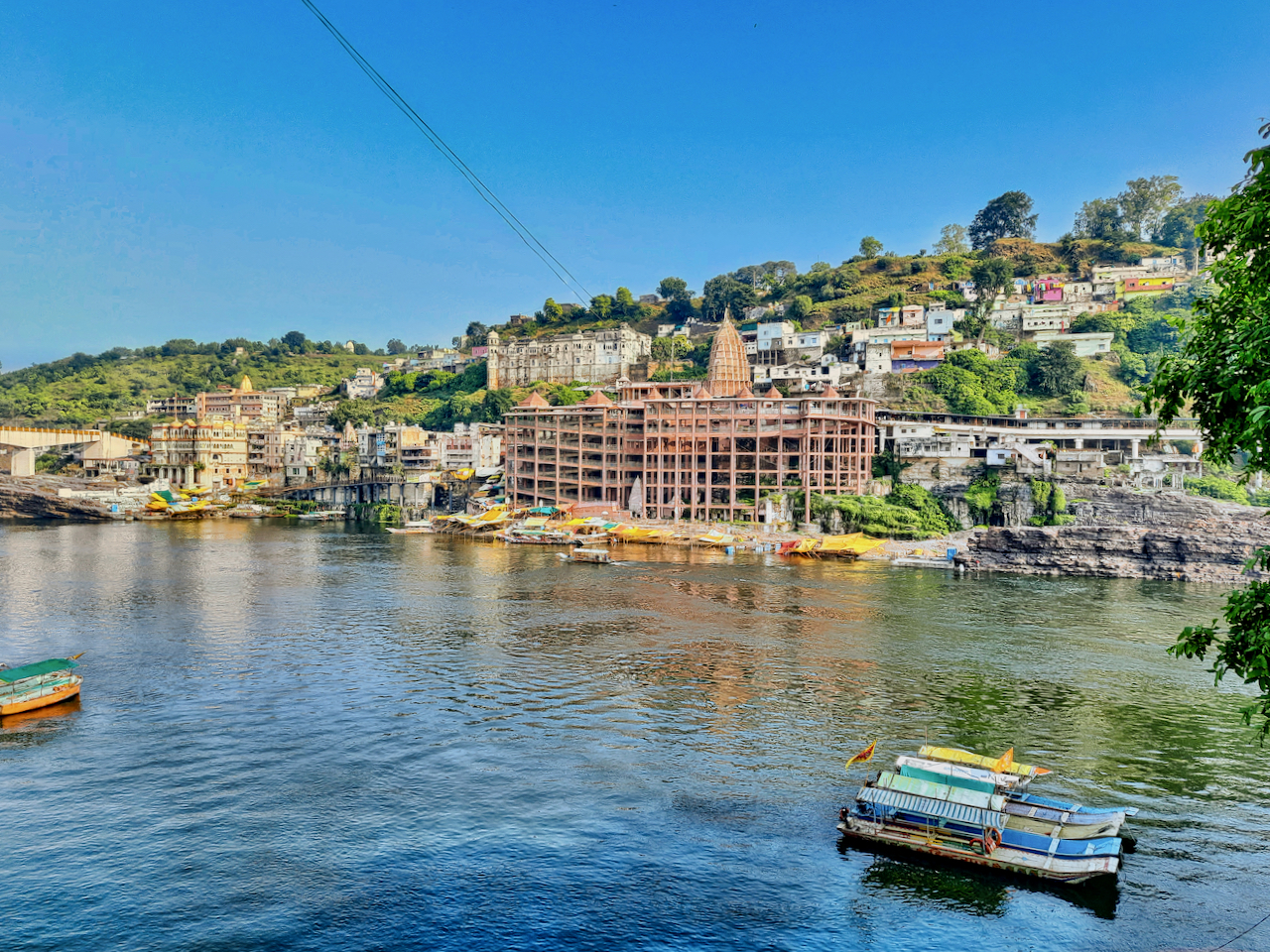
Seen from the river, the temple rises as a tall, multi-storey building crowned by a high spire, with the island hill behind it.
The Trust says the main temple is in the North Indian style with a high spire. It describes an older sanctum that is smaller, with a dome of layered stone, facing north, and a newer part that faces south, which the Trust suggests may explain why the sanctum and the deity do not align with the main door or the topmost spire. The assembly hall is said to be about 14 feet high and supported by 60 large pillars.1Official notice
The Trust also says the temple has five floors, each dedicated to a deity: Omkareshwar, Mahakaleshwar, Siddhnath, Gupteshwar and, at the top, a flag-bearing deity. The sources do not clearly establish Mahakaleshwar’s location relative to the main shrine.12Official notice

02 · Old and new
What is old in the fabric
The Commons description of the photograph on this page records that the modern superstructure is plain Nagara and that the older parts include mandapa pillars and panels depicting Krishna, Ganesha, Vishnu and Durga. This is the uploader's description, not an archaeological report, and we mention it only as an indication that older and newer work sit side by side.3Interpretation
03 · The south-bank shrine
Mamleshwar (Amareshwar)
A specialist article describes the Amareshvara temple as largely reconstructed in the Peshwa period using debris and fragments from other temples. It says its heavily reconstructed 40-pillar mandapa retains six original central pillars, that the shikhara has lost its original form and is now of the latina type, and that the north side of the vimana is well preserved and has a niche of Shiva as Andhakantaka. The Trust says Mahimna Stotras are carved on its walls and that the ASI has declared it a protected monument; we could not verify that notification.42Documented history
04 · Siddhanatha
The open-sided temple on the parikrama path
The Trust lists Siddhnath Temple on the parikrama as a protected monument with elephant statues, an assembly hall with 18 columns and carvings. The specialist article calls it a sarvatobhadra temple, open on all four sides, whose dome-like shikhara, probably Peshwa-period, was dismantled during conservation begun under Henry Cousens around 1903 and largely complete by 1907. The article gives no construction date, and neither do we.54Documented history
Sources and notes
Sources and notes
Each source is marked as inspected for this project or only discovered, so you can see how far a statement has been checked.
- Shri Omkareshwar Mandir Trust, Main Temple (shriomkareshwar.org/MainTemple.aspx). Link Inspected · Accessed 2026-11-14 Trust's account of the island, the legend, the two sanctums, the five floors, the three daily worships and the Monday palanquin. The page itself says there is no authentic record of who built the temple or when.
- Shri Omkareshwar Mandir Trust, Other Temples (shriomkareshwar.org/OtherTemples.aspx). Link Inspected · Accessed 2026-11-14 Trust's descriptions of Mamleshwar (Amreshwar), Mahakaleshwar, Govindeshwar cave, Annapurna and others. Its claims (for example ASI status of Mamleshwar, dating to 1063 AD) are the Trust's and were not checked against ASI or inscription records.
- Ms Sarah Welch. Wikimedia Commons, File:0102621 Omkareswar Jyothirlinga temple, Mandhata Madhya Pradesh 005.jpg (2021). Link Inspected · Accessed 2026-11-14 Licence (CC0) and the uploader's description of the photograph. The description is not a scholarly source.
- Saurabh Saxena. Saurabh Saxena, Omkareshwar: A Shapeless Manifestation of the Non-Manifest (Puratattva, 5 May 2023) (2023). Link Inspected · Accessed 2026-11-14 Web article that cites Cousens, Kielhorn, Sircar and others on the Paramara inscriptions of 1055 and 1063 CE. We read the article, not the cited inscription editions. It argues Amareshvara was the earlier jyotirlinga site; that is the author's view, presented here as interpretation. It attributes the rebuilding to the Peshwa period and does not mention the Holkars.
- Shri Omkareshwar Mandir Trust, Omkar Parvat Parikrama (shriomkareshwar.org/Parikrama.aspx). Link Inspected · Accessed 2026-11-14 Describes a guided walk of about 7 km with a list of stops, 7 AM to 9 AM. The route order and the separate parikrama rules page were not read.
Continue exploring
Continue exploring
- Visit
Plan Your Visit
What are the darshan timings, rules and ways to reach Omkareshwar?
Read chapter - Overview
Omkareshwar
Where is Omkareshwar, what is it, and what is the relationship between Omkareshwar and Mamleshwar?
Read chapter - History
History and Heritage
How old is Omkareshwar, who rebuilt it, and what do the records show?
Read chapter