
Nageshwar 03 / 08
Temple and Architecture
An underground sanctum and a very large statue, with notes on the other two shrines
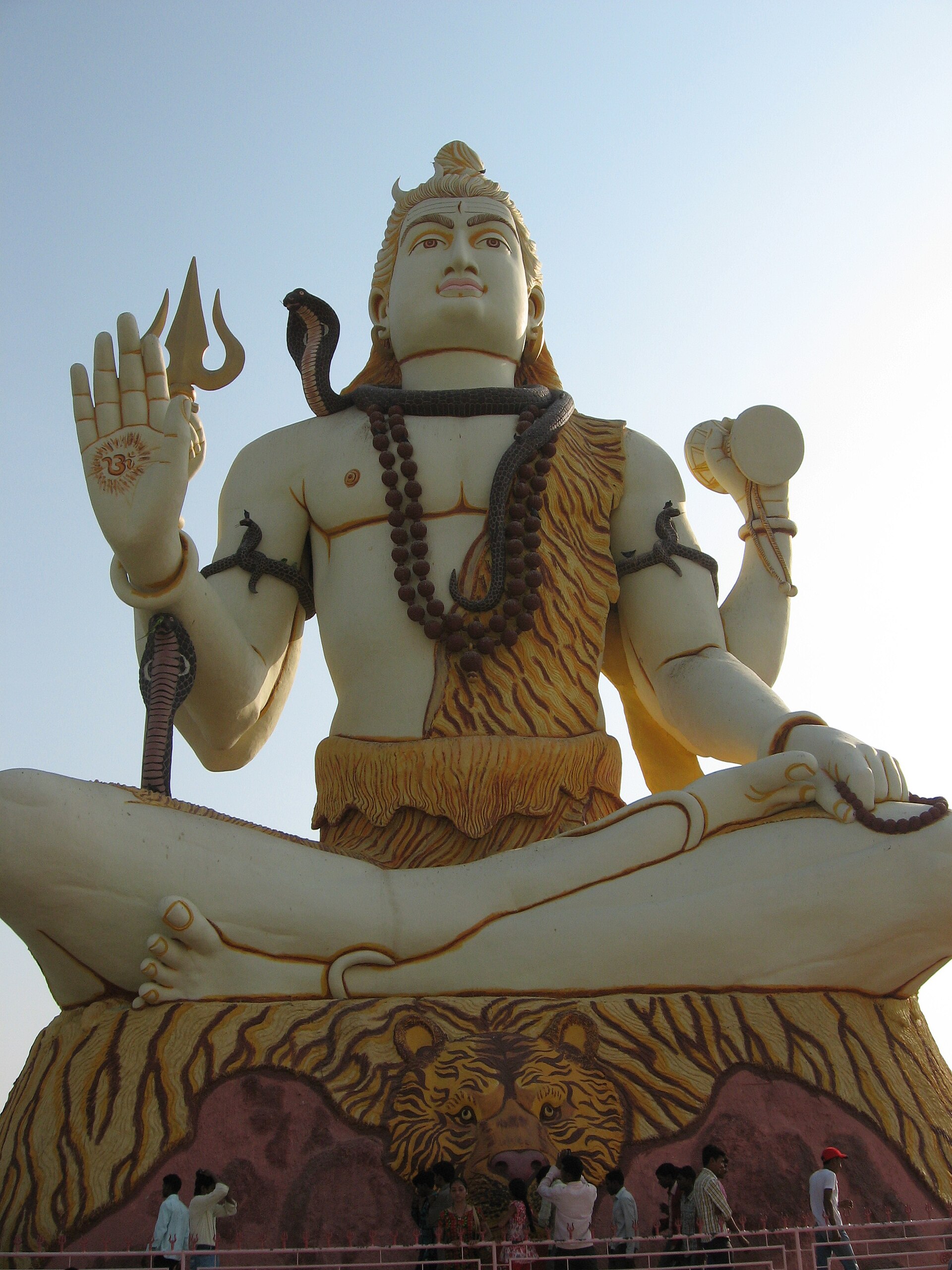
The shrine near Dwarka is described by official pages as having an underground sanctum, a garden and a seated Shiva statue, 25 m tall by the district site. The temples at Aundha Nagnath and Jageshwar are older stone buildings with their own architectural literature, summarised briefly here.
01 · Near Dwarka
Sanctum, garden and statue
The shrine is entered, as described, by going down: the Jyotirlinga is in an underground sanctum, with a large garden and pond around the complex and a towering seated Shiva beside it.
The district website says the sanctum is underground and that a garden with a pond adjoins the temple. Incredible India adds that the lingam is of Dwarka stone, marked with small chakras, and takes the form of a three-faced rudraksha bead, and that the design follows Vastu principles and the posture of a reclining human body. These are descriptions by tourism pages; we have not seen measured plans or an architectural survey.12Official notice
In media item nageshwar-temple, the photograph shows Shiva seated with four arms, a raised palm marked with Om, a trident, a drum, a cobra at the neck and a rudraksha garland, on a base painted with a tiger-skin pattern, as the photograph shows. Official pages give its height differently.Interpretation

02 · The other two
Aundha Nagnath and Jageshwar
Aundha Nagnath is a stone temple in the Hemadpanti style, west-facing within a walled courtyard that holds a stepwell, with a five-part vimana plan and a hall of about 40 ft square on 16 pillars, according to the Puratattva article. The sanctum has two levels, and the lingam lies in the lower one, reached by a low crouching passage. The friezes are compared there to Hoysala work, and the spire is a later rebuilding.34Documented history
Jageshwar is a valley of temple groups. The Kumaon government portal describes the Dandesvara group on two terraces separated by a stream, surrounded by deodar, and a main complex of over a hundred shrines in walled grounds, mostly of stone in a northern Indian style. Wikipedia reports an ASI museum with more than 150 sculptures dated 9th to 13th centuries.56Documented history
Sources and notes
Sources and notes
Each source is marked as inspected for this project or only discovered, so you can see how far a statement has been checked.
- Nageshwar Temple, Devbhumi Dwarka district website (devbhumidwarka.nic.in/tourist-place/nageshwar-temple/). Link Inspected · Accessed 2026-11-14 District administration tourism page. Gives the location on the route to Beyt Dwarka, the underground sanctum, the Vamana Purana legend, the 25 m statue and road access. It lists no visiting hours.
- Nageshwar Jyotirlinga, Dwarka (Incredible India). Link Inspected · Accessed 2026-11-14 National tourism page. Describes an 80 ft seated Shiva statue, an underground sanctum and a list of nearby sites. It gives no distances.
- Saurabh Saxena. Saurabh Saxena, Aundha Naganatha – Patalalinga Jyotirlinga (Puratattva, 13 April 2024) (2024). Link Inspected · Accessed 2026-11-14 Monument-navigator article with a bibliography. Used for dating, style and its discussion of Darukavana; the author's own conclusion is reported as the author's view.
- Aundha Nagnath Temple (Wikipedia). Link Inspected · Accessed 2026-11-14 Gives the 13th-century Yadava dating, Hemadpanti style, Ahilyabai Holkar renovation and an ASI protected-monument claim. The article's references section was empty, so these statements are unverified here.
- Jageshwar temples (Kumaon district portal, kumaon.gov.in). Link Inspected · Accessed 2026-11-14 Government portal text on Jageshwar: dating of the groups, local reverence of Jageshwar as one of the twelve, deodar setting, and ASI custody of one cluster. It gives no distance from Almora.
- Jageshwar (Wikipedia). Link Inspected · Accessed 2026-11-14 Gives temple counts, dating debate, ASI protection and the Shankaracharya attribution (with its stated lack of textual support). The last 10,000 characters were not read.
Continue exploring
Continue exploring
- Visit
Plan Your Visit
How do I visit the Nageshwar temple near Dwarka?
Read chapter - Overview
Nageshwar
Where is the Nageshwar Jyotirlinga, what is the Dwarka shrine, and why is its identity discussed?
Read chapter - History
History and Heritage
Which temple is the real Nageshwar Jyotirlinga, and what is the history of each claimant?
Read chapter